
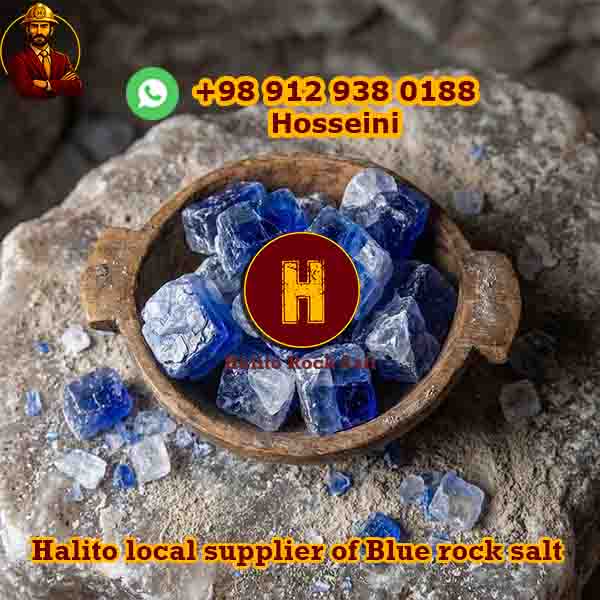
Persian Blue Salt Origin Composition and Market, you can easily purchase orgin blue rock salt from iran local supplier.

Where Is Persian Blue Salt Found?
Persian blue salt is one of the world’s rarest naturally occurring salts, found exclusively in a limited geological zone in northern Iran. The primary deposits are located within the ancient salt mountains of Semnan and Garmsar, regions known for their deep halite formations that date back over 100 million years. These formations originated from a prehistoric ocean that gradually evaporated, leaving behind dense layers of mineral-rich salt.
What makes this salt extraordinary is the unique combination of geological pressure, tectonic movement, and mineral crystallization that occurred only in this specific region. Unlike common sea salts or Himalayan pink salt, which can be mined across multiple countries, the true blue halite crystals appear solely within Iran’s ancient salt domes. Their formation required both immense pressure and the right mineral balance—conditions extremely rare anywhere else on Earth.
Inside the salt mines, blue crystals occur sporadically, often hidden within larger white or transparent halite blocks. Miners must carefully examine the veins of salt to locate these naturally blue fragments. Because of its scarcity, limited geographic origin, and striking appearance, Persian blue salt is classified as a specialty mineral sought after by gourmet chefs, collectors, and high-end retailers worldwide.
How Is Persian Blue Salt Extracted?
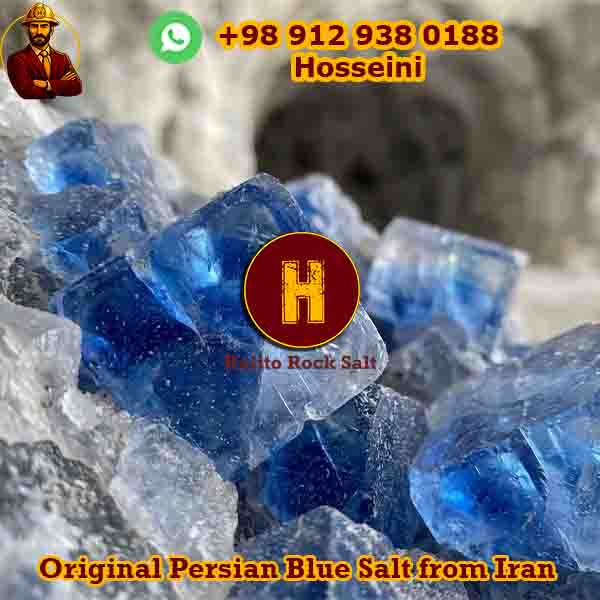
The extraction of Persian blue salt begins deep within Iran’s ancient halite mountains, where miners work inside natural salt caves formed over millions of years. Unlike industrial salts that rely on large-scale mechanical mining, blue salt must be extracted with precision and care because the blue crystals appear only in small pockets within the rock. This selective occurrence requires skilled workers who can identify veins containing the rare blue halite.
The process typically starts with controlled hand excavation. Miners use small chisels and specialized tools to gently separate the surrounding white or transparent halite from the blue fragments, ensuring that the delicate crystal structure is not damaged. Heavy machinery is avoided in the core extraction areas, as vibration and pressure could crack or dull the blue coloration that gives the mineral its high value.
After removing larger salt blocks, the material is transported to processing areas where experts sort the crystals manually. During this stage, blue pieces are isolated from the rest of the salt and then either kept in natural rock form or ground into fine grains, depending on the intended market. Since the blue coloration can fade when overly exposed to light or heat, workers handle and store the crystals under controlled environmental conditions.
This meticulous extraction and sorting process is labor‑intensive and time‑consuming. However, it is precisely this careful handling that preserves the purity, color intensity, and mineral integrity of Persian blue salt. Because of the rarity of the deposits and the complexity of its extraction, the final product is considered a premium-grade gourmet and industrial mineral, valued across global markets.
What Elements Make Up Persian Blue Salt?
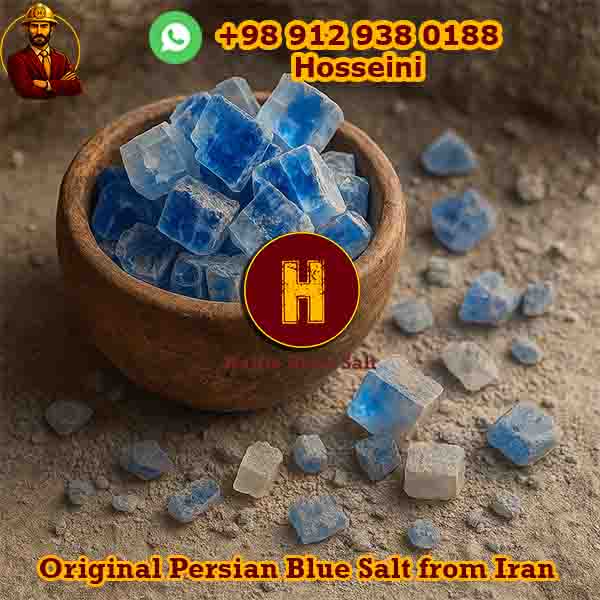
Persian blue salt owes its unique appearance and mineral properties to a combination of natural chemical components that formed under extreme geological pressure. Although it is often admired for its brilliant blue crystals, its composition is primarily based on halite (sodium chloride – NaCl), similar to most natural rock salts. However, what sets it apart is the presence of trace minerals and a rare crystallization process that gives the salt its distinctive character.
The blue coloration is not caused by dyes or impurities; instead, it is the result of a natural optical phenomenon known as the lattice displacement effect. This occurs when potassium chloride (KCl) becomes trapped within the halite structure during the formation of the salt millions of years ago. Under immense pressure, these potassium-rich areas undergo a change that alters how light refracts inside the crystal, producing the blue hue.
In terms of mineral composition, Persian blue salt typically contains:
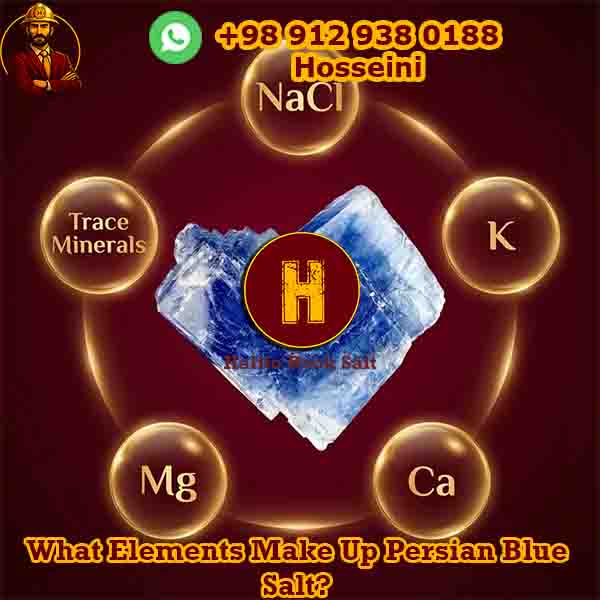
- Sodium Chloride (NaCl): The main component, often 98% or higher in its purest formations.
- Potassium (K): Responsible for the blue tint and contributes to the mineral richness.
- Calcium (Ca): Provides subtle nutritional value and affects crystal hardness.
- Magnesium (Mg): Present in small amounts, contributing to the salt’s mild flavor complexity.
- Trace Minerals: Including iron, zinc, and other micro‑elements found naturally in ancient halite deposits.
These minerals work together to create a salt that is not only visually extraordinary but also valued for its mild, slightly sweet taste and smooth mineral finish. Unlike aggressively salty industrial products, Persian blue salt is often described by chefs as “delicate,” making it ideal for gourmet dishes, finishing salts, and luxury culinary presentations.
Because the blue color occurs only in limited pockets of the Iranian salt mountains, its mineral structure cannot be replicated synthetically without losing authenticity. This makes genuine Persian blue salt both a geological rarity and a high-demand product in international specialty markets.
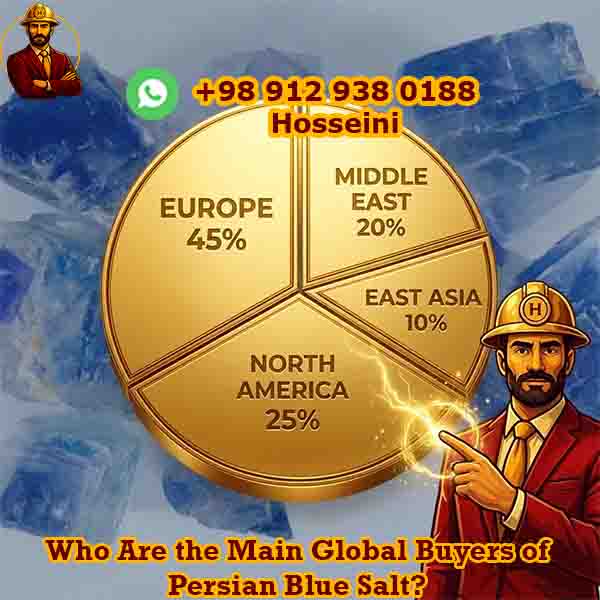
Who Are the Main Global Buyers of Persian Blue Salt?
Because Persian blue salt is one of the rarest natural salts in the world, the countries that import it tend to fall into two categories:
gourmet food markets and premium wellness/luxury segments.
Production is limited to a few mines in Iran, mainly in Semnan and Garmsar, which makes availability restricted and demand consistently high.
In the global salt market, blue salt occupies a niche position. While it represents a tiny percentage of overall salt trade, its high price per kilogram and its rarity make it a premium export commodity.
Over the past decade, consumer interest in rare culinary ingredients, mineral-rich salts, and aesthetically distinctive food products has increased noticeably, driving demand across Europe, North America, and parts of Asia.
1. European Union: The Largest and Most Stable Market
The European market accounts for a significant portion of total Persian blue salt imports. Countries such as:
- Germany – One of the biggest buyers, using it for gourmet shops, specialty butchers, and high-end restaurants.
- France – Strong demand from Michelin-star restaurants and luxury retail chains.
- Italy – Popular among artisanal food producers and fine-dining establishments.
- Spain – Used heavily in tapas bars and premium food boutiques.
- Netherlands & Belgium – Key transit and re-export hubs for blue salt distribution across Europe.
The EU’s emphasis on authenticity, clean-label ingredients, and origin-certified products makes Persian blue salt particularly attractive. importers in Europe often highlight its geological age, natural blue crystal formation, and rarity to justify premium pricing.
2. Middle East & GCC Countries
High-income markets in the Middle East have shown increasing interest in rare culinary and wellness products. The primary buyers include:
- United Arab Emirates – Especially Dubai; blue salt is sold in luxury malls and upscale organic markets.
- Qatar – Premium hospitality chains use it for specialty dishes.
- Kuwait & Bahrain – Imports for gourmet home-use and specialty shops.
Because these markets appreciate high-end packaging, many exporters focus on supplying the product in small, polished, retail-ready containers with strong visual presentation.
3. North America: Growing Market with High Margin Potential
Demand in the United States and Canada has grown steadily, fueled by:
- Health-conscious consumers looking for mineral-rich salts.
- Chefs and food influencers featuring blue salt on social media.
- Specialty food stores that prefer small-batch, rare imports.
The U.S. market in particular is receptive to descriptive storytelling—highlighting the Iranian origin, geological uniqueness, and artisanal extraction methods tends to significantly boost sales margins.
4. East Asia: Limited but Strong Premium Demand
Although the total volume is smaller than Europe or North America, East Asian markets often have the highest willingness to pay per kilogram, especially for well-packaged, visually appealing products. Key destinations include:
- Japan – Blue salt is used in fine restaurants and as a high-end gift item.
- South Korea – Growing interest in luxury salts for both cooking and spa/beauty treatments.
- Hong Kong & Singapore – Strong boutique and gourmet retail presence.
Packaging presentation plays a major role in these markets—clear jars, gold-foil labels, and certificates of authenticity increase purchase likelihood.
Summary: Why These Countries Lead the Market
In all these regions, consumers are attracted by a similar set of value drivers:
- Rarity – Only found in a few mines in Iran.
- Visual uniqueness – The natural blue crystal structure is unlike any other salt.
- Premium positioning – Suitable for gourmet cuisine and high-end retail.
- Clean, natural mineral composition – No additives or artificial coloration.
These factors help Persian blue salt maintain a stable presence in international luxury markets, despite its limited production volume.
Introducing Halito: Iran’s Premier Supplier of Persian Blue Salt
Halito is recognized as one of Iran’s most trusted and specialized suppliers of
Persian Blue Salt, providing authentic,
naturally extracted crystals directly from the rare deposits of Semnan and Garmsar.
With more than a decade of experience, Halito has built a strong reputation for
delivering high‑purity salt stones, consistent quality, and reliable global logistics.
What Makes Halito Different?
• Direct Access to Mines: Halito sources its products directly from
certified mines, ensuring authenticity and mineral integrity.
• Premium Grade Sorting: Each batch is hand‑selected and classified into
food‑grade, industrial‑grade, and decorative‑grade crystals.
• Strict Quality Control: All shipments undergo visual inspection,
moisture analysis, and purity testing before packaging.
• Customized Packaging: From 20‑kg industrial bags to luxury glass jars
for gourmet markets, Halito meets a wide range of customer needs.
• Worldwide Shipping: Fast and safe export to Europe, the Middle East,
North America, and East Asia.
Products Offered by Halito
• Persian Blue Salt Granules (1–5 mm)
• Persian Blue Salt Powder
• Large Blue Salt Crystals for decoration and luxury displays
• Blue Salt Stones for spas and wellness centers
• Mixed Himalayan & Persian Blue Salt Blends
Why Global Buyers Choose Halito
Halito stands out not just because of access to rare sources, but because of its
commitment to consistent quality. Restaurants, gourmet brands, health‑food stores,
and importers rely on Halito for:
• stable supply capacity,
• authentic blue coloration caused by sylvite minerals,
• long‑term delivery contracts,
• competitive export pricing,
• and professional documentation for customs clearance.
Halito’s Mission
Halito aims to introduce the world to the beauty and rarity of
Persian Blue Salt while supporting sustainable
mining practices and empowering local communities within Iran’s salt‑rich regions.
Halito – Where Authentic Persian Blue Salt Begins.


No comment