
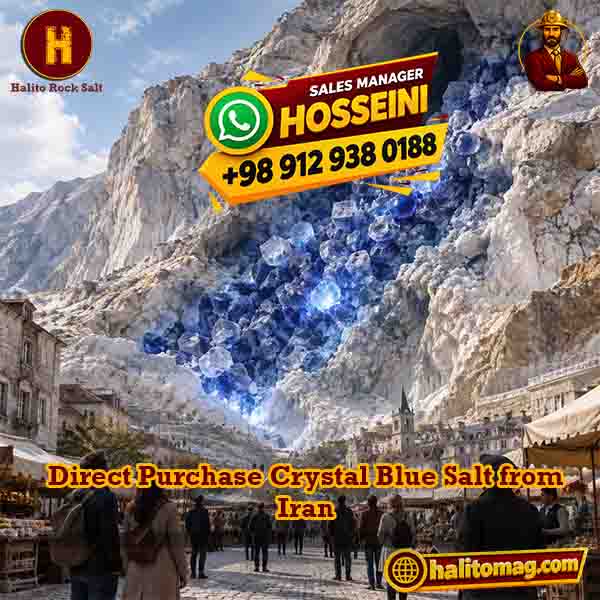
Few natural ingredients on Earth captivate executive chefs, mineral collectors, and health enthusiasts quite like Persian Blue Salt. Harvested exclusively from ancient evaporated seabed deposits in Northern Iran, this striking blue gem is one of the rarest, most visually stunning, and chemically distinct salts in existence.

Unlike pink Himalayan salt or grey Celtic salt, whose hues stem from trace iron oxides or clay particles, the vibrant indigo veins of Persian blue salt are the result of an extraordinary geological phenomenon—an optical illusion preserved inside a 100-million-year-old crystalline lattice.
Whether you are seeking to understand the unique physics behind its sapphire color, evaluate its mineral profile for commercial importing, or source authentic blue halite for gourmet cuisine, this definitive guide covers everything you need to know about Persia’s most coveted mineral.
Earth’s Rarest and Most Mysterious Mineral: Persian Blue Halite
Among the thousands of natural minerals cataloged by geologists, Persian Blue Salt (scientifically known as blue halite) occupies an elite status. It is neither a newly engineered luxury spice nor a culinary novelty enhanced with artificial pigments. Instead, it represents an extraordinary geological anomaly—an ancient, prehistoric evaporite that has preserved the dynamic tectonic forces of the Earth for over 100 million years.
While standard table salt, white rock salt, and even pink Himalayan halite are extracted in quantities of millions of metric tons per year from massive, predictable strata, Persian blue salt defies conventional mass-mining logistics. It does not exist in solid subterranean seams. Instead, it occurs exclusively as thin, sporadic, and unpredictable crystalline veins embedded within ancient salt domes in northern Iran.
The Mystery of Scarcity: A True 1-in-a-Million Phenomenon
For every several tons of high-purity white rock salt meticulously extracted from the underground depths of Garmsar, only a few kilograms of authentic sapphire-blue crystal are recovered. This extreme natural rarity places Persian blue salt on par with rare gemstones rather than everyday agricultural commodities.
To executive chefs, luxury spice connoisseurs, and international mineral collectors, this vivid indigo crystal is celebrated not only for its striking visual drama but for its unadulterated purity, delicate sensory texture, and profound geological journey from a dried prehistoric ocean bed to modern haute cuisine.
The Enigma of the Sapphire Crystals
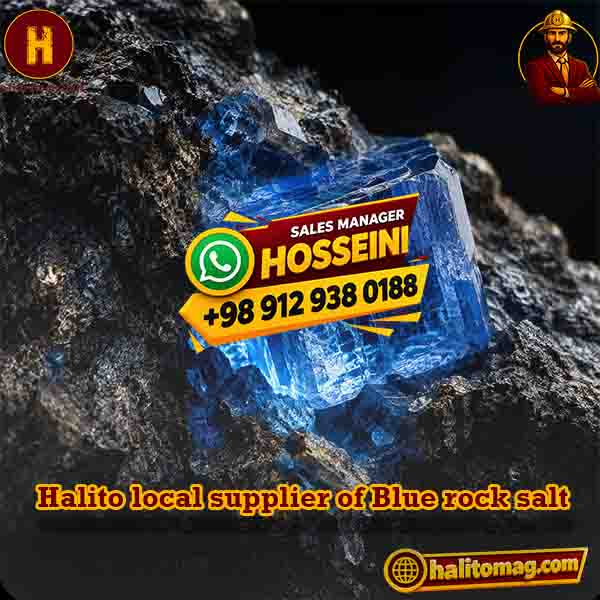
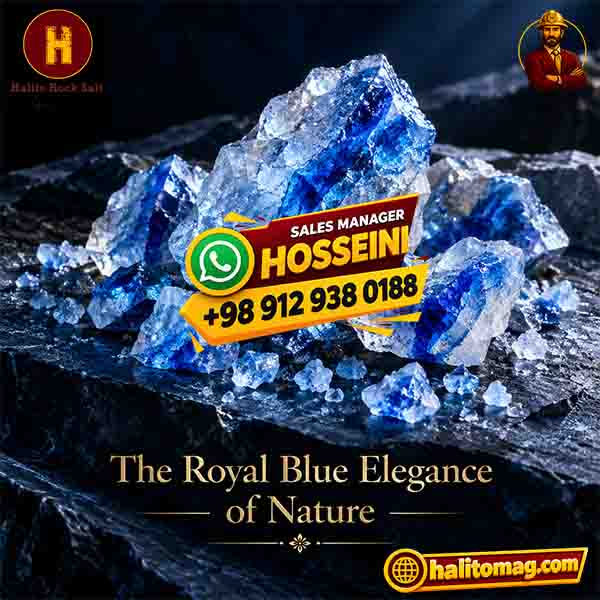
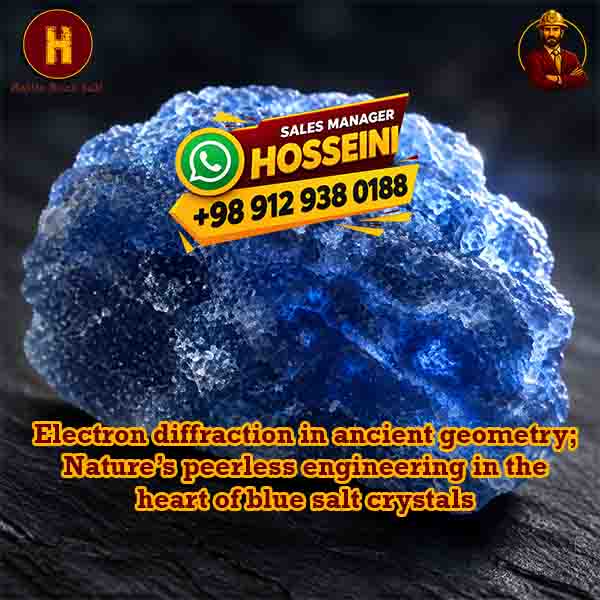
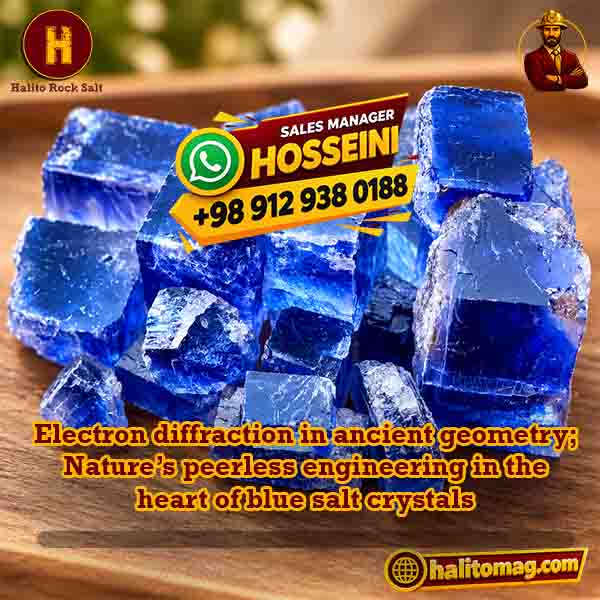
At first glance, a batch of authentic Persian blue salt crystals resembles a scattered collection of raw sapphires or lapis lazuli. The vibrant intensity of its color—ranging from delicate sky-blue highlights to deep, mesmerizing navy flecks—creates an immediate visual enigma for anyone encountering this mineral for the first time.
In the culinary and mineralogical worlds, natural color typically signifies chemical impurities or trace element concentrations. For example, pink Himalayan salt derives its rosy hue from iron oxide minerals, while black volcanic salts gain their dark color from activated charcoal or iron sulfides. Persian blue salt, however, completely defies this expectation.
The Optical Mystery: Color Without Pigment
Chemical laboratory analyses consistently reveal a striking paradox: Persian blue salt contains zero blue dyes, organic pigments, or heavy metal impurities. The sapphire hue is entirely a physical illusion generated by extreme structural compression within the sodium chloride crystal matrix over tens of millions of years.
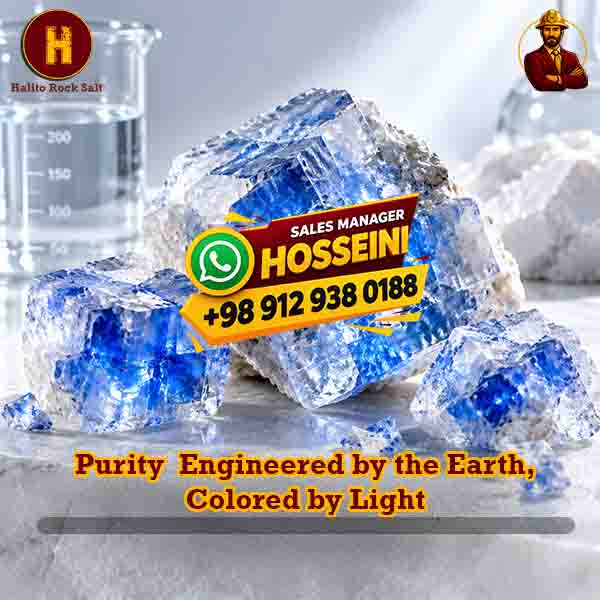
Because this color is born from physical crystal lattice dislocations rather than chemical staining, grinding or dissolving the crystal dramatically changes its appearance. When dissolved in water, the liquid remains 100% crystal-clear—proving that the brilliant blue shade is an intimate gift of subterranean physics rather than added coloring.
This unique optical mystery makes these sapphire-like halite crystals not only a crown jewel for Michelin-starred plating and luxury mixology, but also one of the most fascinating study subjects in modern optical mineralogy.
Persian Blue Salt: At a Glance
Geographical Origin
Semnan Province (Garmsar Salt Domes), Northern Iran.
Mineral Classification
Natural Blue Halite with Potassium-rich Sylvinite inclusions.
Color Phenomenon
Optical light refraction (F-Centers / Lattice Defects); 0% chemical pigments or dyes.
Sensory & Flavor
Intense initial saltiness followed by a mild, sweet herbal finish due to potassium.
Chemical Composition
High-purity NaCl (>95%), enriched with Potassium (K: 1.2–3.5%), Ca, and Mg.
Extraction Method
100% Hand-harvested from subterranean erratic veins; manually chiseled & sorted.
✅Lab Certified (COA): Guaranteed free from heavy metals, microplastics, additives, and artificial dyes.
The Geological Origin: 100 Million Years in the Making
To truly understand why Persian blue salt is so rare and so deeply treasured, one must look far beyond a single mine shaft or batch of crystals. Its story began in the Mesozoic Era, when a vast prehistoric inland sea covered the region now known as the Iranian plateau. Endless cycles of evaporation and tectonic upheaval transformed this ancient body of water into sprawling evaporite basins rich in the essential building blocks of salt: sodium, chlorine, potassium, and magnesium.
As millions of years passed, the relentless arid desert heat drew the sea level downward, leaving behind massive crystalline salt beds buried deep beneath the earth’s crust. This single geological event set the stage for everything that makes Persian blue salt exceptional today.
Inland Sea
➜
Evaporation
➜
Pressure
➜
Domes
🌋 The Tectonic Force That Built the Domes
Approximately 30 million years ago, the collision of the Arabian and Eurasian tectonic plates—the very force still shaping the Zagros and Alborz mountain ranges—compressed the deeply buried salt strata. Under unimaginable subterranean pressure and heat, these ancient salt beds were forced upward, squeezing through the overlying rock like toothpaste. This colossal geological movement gave birth to the dramatic salt domes (namakdans) of the Semnan province, most notably the celebrated Dome of Garmsar.
🗺️ Why Garmsar, Iran?
While standard white rock salt is extracted by the millions of tons from vast, predictable strata worldwide, Persian blue halite occupies only a minimal fraction of the total rock mass. The blue veins occur not as deep, continuous seams, but as thin, erratic ribbons randomly scattered within the salt dome.
⚠️ Scarcity Metric: Out of several tons of extracted premium white salt, miners recover only a few kilograms of authentic sapphire-blue crystal. This scarcity drives its premium valuation across global gourmet markets.
From ancient inland seas to the enormous geological pressures of the Garmsar salt dome, this 100-million-year journey is exactly why every single blue crystal tells a story of deep time—making Persian blue salt not merely a seasoning, but a wearable piece of Earth’s history on a gourmet plate.
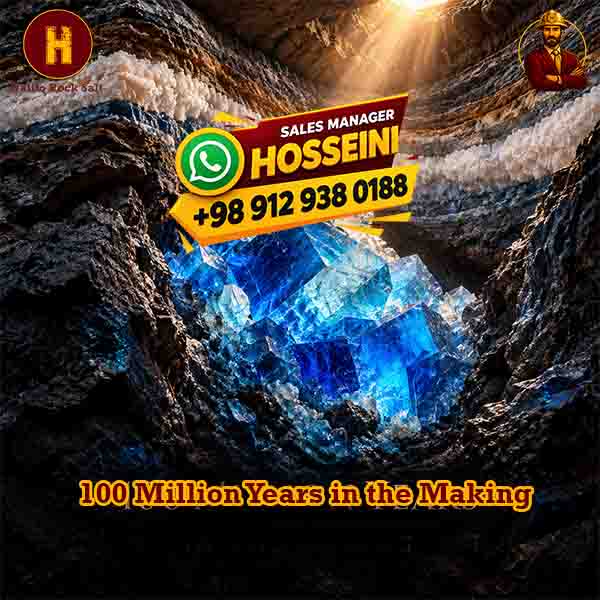
From Prehistoric Oceans to Ancient Salt Domes
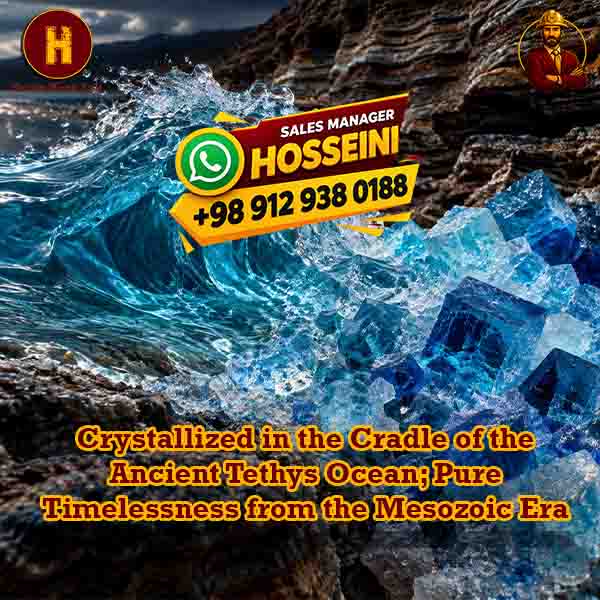
The genesis of Persian Blue Salt is deeply rooted in the dramatic paleogeographic shifts of the Mesozoic and Tertiary periods. During these eras, widespread marine regression isolated massive arms of the ancient Tethys Ocean across the Iranian plateau, establishing hyper-saline inland basins under intense arid climatic conditions.
Evaporite Basin Formation
As solar evaporation vastly outpaced freshwater inflow, sequential precipitation of marine salts occurred. Calcium sulfates settled first, followed by colossal, multi-layered strata of pure sodium chloride and potassium-bearing salts over millions of uninterrupted years.
Deep Burial & Isolation
Gradual continental subsidence and thick sedimentary overburden safely sealed these fragile evaporite deposits beneath thousands of meters of protective rock, protecting them entirely from modern surface pollutants, moisture, and environmental degradation.
🔬 Scientific Significance: This prolonged cyclic evaporation in an isolated closed basin created the unique geochemical environment necessary for potassium (Sylvinite) inclusions to crystallize alongside halite lattice defects—the fundamental scientific prerequisite for the iconic sapphire blue coloration.
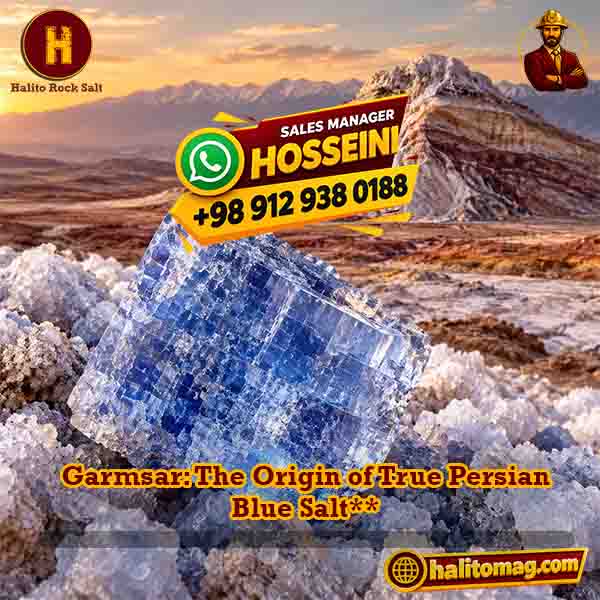
Garmsar and the Semnan Basin: Why Only Iran?
While salt deposits exist across every continent, true Persian blue salt is geographically restricted to a single, extraordinary landscape on Earth: the northern fringe of the Dasht-e Kavir (Great Salt Desert) within the Semnan Province, surrounding the historic city of Garmsar, Iran.
Anatomy of Garmsar Salt Domes
The unique collision point of the Alborz mountain range and the central Iranian plateau generated intense salt diapirism (diapirs/namakdans). Over millions of years, vast buoyant underground salt masses pierced thousands of meters of overlying rock, rising to form towering, complex salt domes.
Sylvinite Mineral Synergy
Garmsar’s subterranean geological structures provided the precise chemical ratio of potassium chloride (Sylvite) intermixed with halite. Without this specific potassium concentration and immense tectonic stress, blue lattice defects simply cannot form elsewhere in the world.
🏜️ The Dasht-e Kavir Factor
The hyper-arid climate of the Dasht-e Kavir desert preserved these delicate geological structures for millennia. Rainlessness prevented water percolation from dissolving the soluble sylvinite veins, safeguarding the underground blue crystals in their purest, unadulterated state.
🌐 Global Monolith: Unlike pink or black rock salts mined in multiple countries, genuine sapphire blue halite is a 100% exclusive geological signature of Iran’s Semnan basin—making Garmsar the sole supplier of authentic Persian blue salt to the global market.
The Science Behind the Blue: Why Is Persian Salt Blue?
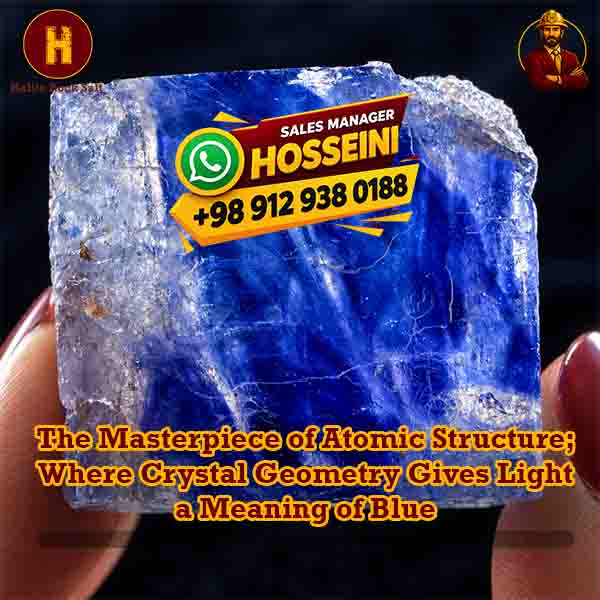
Persian Blue Salt is not dyed. Its sapphire hue is a result of a rare geological occurrence known as lattice defect (F-centers), caused by the intense tectonic pressure on potassium-rich sylvinite deposits trapped within Iranian salt domes.
🔦 What are F-Centers?
Under immense geological pressure, the crystalline structure of the salt is compressed. This shifts the atomic lattice, creating tiny “voids” where electrons become trapped. These trapped electrons, known as Farbe centers (F-centers), refract light in a way that absorbs the yellow-red spectrum and reflects only the deep blue light.
🧪 The Role of Sylvinite
Unlike common white table salt (Sodium Chloride), Persian Blue Salt contains significant traces of potassium chloride (Sylvinite). This mineral synergy is essential; without the specific potassium concentration found in the Semnan region, these F-center defects cannot form.
⚠️ Authenticity Check: Authentic Persian Blue Salt never fades when ground. Because the color is a structural property of the crystal lattice (not a surface coating), the resulting powder should retain a distinctive bluish or whitish-gray tint, never pure white.
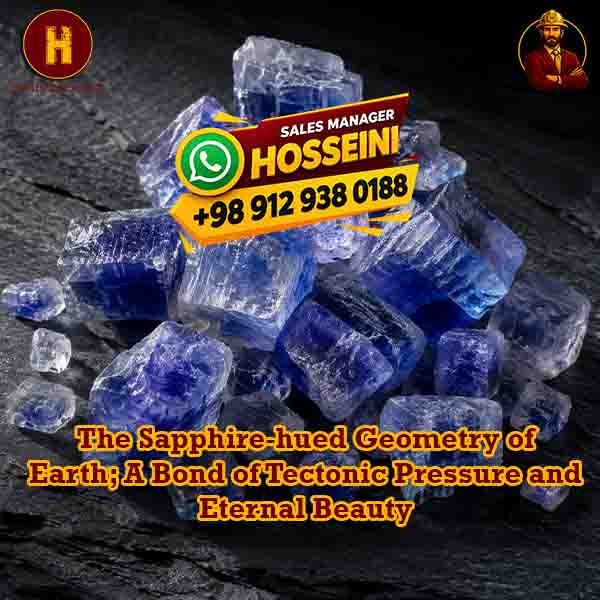
The Sylvinite & Optical Illusion Phenomenon
To truly understand why Persian Blue Salt captivates the human eye, we must examine the microscopic interplay between halite (sodium chloride) and sylvinite (potassium chloride). This mineral combination creates a fascinating optical illusion rooted in solid-state physics.
Sylvinite Integration
As prehistoric basins dried, potassium chloride crystallized right alongside sodium chloride. Rather than forming a separate chemical compound, potassium atoms embedded directly into the gaps and irregularities of the cubic halite crystal matrix.
The Optical Scattering
When ambient light strikes these strained, defect-laden crystals, the internal structure causes a unique wavelength diffraction. Longer wavelengths (yellow, orange, red) are absorbed or canceled out, while shorter wavelengths (deep blue spectrum) scatter outward.
🔬 The Illusion Explained: Much like the blue color of deep ocean water or atmospheric Rayleigh scattering, the blue hue of Persian salt is not a pigment, but a magnificent optical illusion born from atomic compression and light diffraction.
Structural Defect vs. Chemical Pigment
A prevailing myth in the gourmet salt industry suggests that the blue hue is caused by exotic mineral additives or external dyes. Science proves otherwise. The blue color is not an additive; it is a structural modification of the crystal lattice itself.
🏗️ The Physics of F-Centers
Over millions of years, intense tectonic pressure creates tiny defects in the salt’s cubic structure. These gaps, technically known as F-centers (Farbe centers), trap electrons that would otherwise be part of the chemical bond. These trapped electrons are responsible for the light-refractive properties that produce the blue color—not chemical pigments.
🚫 Absence of Chemical Dye
Authentic Persian Blue Salt is 100% natural. If the color were a chemical pigment or impurity, the salt would fade or bleed when dissolved in water or ground into powder. Because the blue is a structural defect, the crystals retain their color and integrity through the entire grinding process.
💡 Expert Insight: The blue we see is an optical manifestation of atomic displacement. This makes Persian Blue Salt not just a condiment, but a geological anomaly, confirming that its value lies in its physical rarity rather than simple coloration.
Chemical Purity & Elemental Breakdown
Transparency is our priority. Below are the verified results from our latest laboratory analysis conducted for Adak Garmsar Salt. These figures confirm the exceptional purity of our natural blue crystal harvest.
| Component / Characteristic | Sample Value |
|---|---|
| Sodium Chloride (NaCl) | 99.6% |
| Loss on Drying (110°C / 2h) | 0.16% |
| Calcium (as CaSO4) | 0.0272% |
| Calcium (as Ca) | 0.008% |
| Magnesium (Mg) | 0.0% |
🔬 Need the full document? Click below to download the official Certificate of Analysis.
Heavy Metals & Purity Standards
In an era where modern industrial pollution threatens marine environments and surface water sources, consumer safety is paramount. Unlike sea salts harvested from contemporary oceans—which are increasingly exposed to microplastics and industrial runoff—Persian Blue Salt is protected deep within ancient underground domes for millions of years.
🚫 Zero Heavy Metals
Independently tested and verified to be entirely free from harmful heavy metals such as lead, mercury, arsenic, and cadmium, guaranteeing a pristine culinary experience.
🌊 100% Microplastic-Free
Because our salt originates from prehistoric inland deposits sealed beneath thick tectonic layers, it remains completely untouched by modern ocean microplastics.
✨ No Additives or Anti-Caking Agents: Our blue salt is 100% natural, unrefined, and free from any chemical bleaches, artificial coloring, or anti-caking additives. What reaches your table is pure, geological crystal perfection.
The Art of Extraction: From Deep Earth to Your Table
⚠️ Why Industrial Mining Destroys Quality
Persian Blue Salt is a geological anomaly—fragile, rare, and sensitive. Industrial mining techniques, which rely on heavy excavators and crushing machinery, are detrimental to the crystal structure. These machines do not discriminate; they pulverize the delicate blue veins alongside common white salt, leading to a loss of the very mineral concentration that creates the blue hue. We strictly avoid these methods to ensure the integrity of every single crystal.
💎 Precision Sorting & Grading: The Blue Spectrum
Quality is not accidental; it is deliberate. Every batch of our salt undergoes a rigorous hand-selection process. Skilled local miners carefully extract the raw rock, followed by a meticulous grading phase to categorize the salt based on color intensity and purity levels.
Deep Blue (The Rare Grade)
Selected for the highest mineral density and most vivid blue sapphire color. Ideal for high-end culinary finishing.
Mixed Light Blue
A beautiful balance of clear white crystals and subtle blue streaks, perfect for everyday gourmet cooking.
| Feature | Persian Blue | Himalayan Pink | Fleur de Sel |
|---|---|---|---|
| Origin | Iran (Semnan) | Pakistan (Himalayas) | France (Sea Salt) |
| Color Source | Natural Sylvinite | Iron Oxide | Harvested Salt |
| Flavor | Sharp → Sweet | Mildly Mineral | Delicate |
| Rarity | Extremely High | Low (Mass Market) | Medium |
Taste Profile and Culinary Applications
⚡ The “Flavor Shock”: Initial Saltiness Followed by Mild Sweetness
The sensory experience of Persian Blue Salt is unlike any common sea or rock salt. Upon first contact with the palate, it delivers a sharp, immediate burst of clean saltiness. This is instantly followed by a surprisingly smooth, complex, and subtly sweet mineral finish, entirely devoid of the harsh, bitter metallic aftertaste often found in low-grade commercial salts. This unique sensory profile is driven by its rich potassium (Sylvinite) content and trace mineral harmony.
🌟 How Michelin-Starred Chefs Use Persian Blue Salt
Because of its striking sapphire crystals and delicate structure, top culinary artists treat blue salt primarily as a Finishing Salt rather than a cooking salt. Here is how elite kitchens elevate their dishes with it:
Crushed lightly over prime cuts like Wagyu or Ribeye just before serving to add crunch and depth.
Enhances pan-seared scallops, lobster tails, and delicate white fish with a clean ocean profile.
Garnishing dark chocolate truffles, salted caramels, or rimming artisan cocktail glasses.
⚠️ What NOT to Do with Blue Salt (Crucial Tip)
Never throw blue salt crystals into a boiling pot of soup, stew, or pasta water during the cooking phase. Because the blue color is an optical illusion caused by structural lattice defects (F-centers), complete dissolution in large amounts of boiling water will cause the sapphire crystals to melt into a clear, ordinary saline solution—completely wasting its stunning visual aesthetic and luxury value. Always save it for the final presentation table!
Health Benefits and Modern Myths
✅ The Real Benefits: Purity and Mineral Balance
Persian Blue Salt is distinguished by its natural mineral composition. Unlike refined commercial table salts, which are often bleached and stripped of natural minerals, our Blue Salt retains its geological integrity:
- Natural Potassium Content: Rich in Sylvinite, it provides a unique mineral profile that some health experts suggest supports better electrolyte balance compared to pure sodium chloride.
- Zero Additives: Crucially, it is completely free from anti-caking agents (such as potassium ferrocyanide or sodium aluminosilicate) often added to industrial salts to prevent clumping.
- Mineral Harmony: Contains natural trace elements like calcium and magnesium that are preserved from the prehistoric sea beds of the Semnan basin.
🔍 Separating Fact from Fiction: Debunking Myths
In the digital age, many blogs promote Persian Blue Salt as a “miracle cure” for a laundry list of chronic ailments. It is essential to be clear: Persian Blue Salt is not a therapeutic panacea or a replacement for medical treatment.
While it is arguably one of the cleanest, most organic, and unrefined salts on the planet, it remains a seasoning mineral. Its primary health value lies in what it lacks (industrial contaminants) and its natural, unadulterated state—not in any magical or medicinal property. We believe in transparency over hype, ensuring our customers know they are consuming an elite culinary product, not a medical supplement.
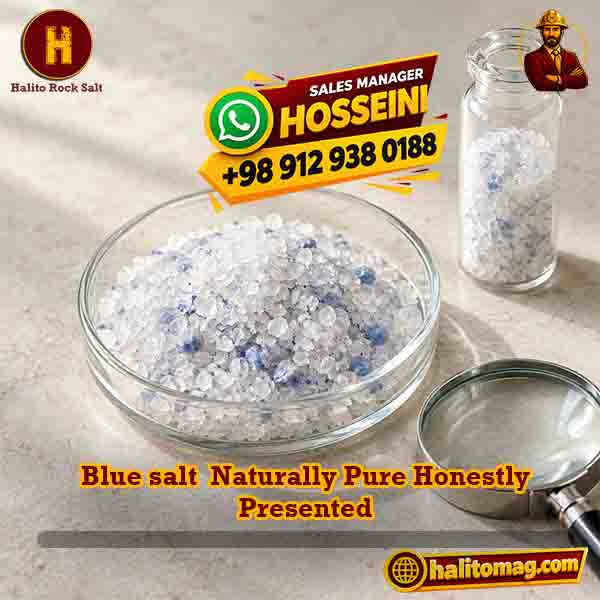
The Fake Market: How to Identify Authentic Persian Blue Salt
💧 The Water Test (Dissolution Reality)
Because genuine Persian Blue Salt derives its color from structural lattice defects (F-centers) within the crystal—not from surface dyes—it must react naturally when dissolved. The Test: Drop a crystal into a glass of clean water.
If the water begins to turn blue or leaves a residue of pigment, it is 100% fake. Authentic blue salt will dissolve slowly, leaving the water perfectly clear. The color is purely an optical phenomenon of the crystal structure, not a chemical coating. If you see blue dye in your water, you are looking at artificial coloration.
💎 Examining Crystal Inclusions
Nature is rarely uniform. When examining authentic Persian Blue Salt under a light, look for these natural indicators:
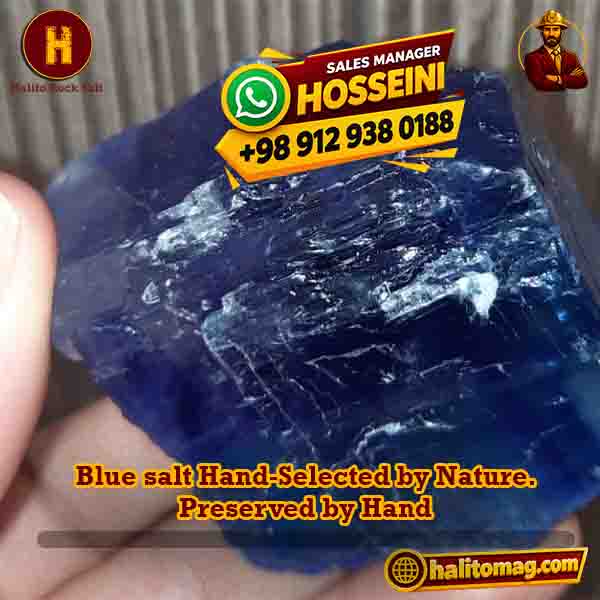
- Irregular Blue Veining: Authentic crystals do not have a “painted” or uniform blue surface. They feature deep, concentrated blue veins and patches where the Sylvinite (potassium) is densely packed.
- Transparency Variations: A real crystal will have varying degrees of clarity. Some parts will be crystal clear, while others are cloudy or deeply saturated with blue. Fakes often look artificially bright and monochromatic.
- Surface Texture: Real salt has a jagged, natural rock texture. If the “blue” looks like a uniform, matte finish applied to the exterior, proceed with extreme caution.
Commercial & Wholesale Buying Guide
⚖️ Precision Grain Sizes for Every Need
Understanding that different markets require different applications, we offer standardized processing for Persian Blue Salt, ensuring consistent quality across all volumes:
For luxury packaging, decorative displays, or high-end retail grinders.
Ideal for uniform distribution and high-end culinary table-salt usage.
Perfect for specialized spice blends and professional gourmet kitchens.
🌍 Export Standards, Packaging & Humidity Control
Exporting a hygroscopic mineral like blue salt requires strict logistical discipline. To ensure our salt reaches EU, North American, or Gulf markets in pristine condition, we adhere to:
- Moisture-Resistant Packaging: Double-layered, food-grade barrier bags to prevent clumping and preserve mineral integrity during ocean freight.
- International Compliance: Full adherence to export phytosanitary and mineral analysis standards required by European and Gulf import authorities.
- Custom Bulk Solutions: We offer white-labeling and flexible bulk volumes tailored to your brand’s specific logistics needs.
Frequently Asked Questions
Why is Persian Blue Salt blue?
The blue hue is a natural optical phenomenon. It is caused by structural lattice defects (F-centers) within the salt crystals, combined with the presence of sylvinite. Over millions of years, intense tectonic pressure altered the crystal structure, causing light to diffract in a way that appears blue.
Is Persian blue salt real or dyed?
Authentic Persian Blue Salt is 100% natural. The color is geological, not added. Be cautious of cheap imitations; genuine blue salt has a specific, translucent crystalline structure. If the “blue” looks like a surface coating or rubs off on your fingers, it is artificial.
Why does the blue color disappear when dissolved?
Because the color is not a chemical pigment, but a structural light diffraction effect. When you dissolve the crystal in water, you destroy the unique lattice structure that traps light. Consequently, the blue optical effect vanishes, leaving behind clear saline water.
How is it different from Himalayan Pink Salt?
They have different geological origins and mineral profiles. Himalayan salt is colored by iron oxide (pink). Persian Blue Salt is much rarer, extracted from subterranean salt domes, and colored by sylvinite, offering a completely distinct mineral depth and “flavor shock.”
What does Persian blue salt taste like?
It provides an initial sharp, intense saltiness that rapidly mellows into a subtle, clean, and slightly sweet mineral finish. It is prized by chefs not just for its color, but for this complex aftertaste that lacks the harsh bitterness often found in industrial salts.
Is it safe for daily consumption?
Yes. It is a high-purity, unrefined natural mineral salt. Because it contains no anti-caking agents, bleaching chemicals, or artificial additives, it is considered one of the cleanest options for gourmet culinary use. As with any salt, consume in moderation.
Is blue salt healthy for high blood pressure?
While Persian Blue Salt is a cleaner, unrefined product compared to processed table salts, it is still primarily Sodium Chloride. Individuals with high blood pressure should always consult their physician regarding salt intake, regardless of the mineral source.
How should I store Persian Blue Salt?
Blue Salt is hygroscopic (absorbs moisture from the air). To maintain its crystalline structure and prevent clumping, store it in an airtight container in a cool, dry place. Avoid keeping it near steam or heat sources.
Does authentic Persian Blue Salt come with a COA?
Yes. Professional B2B suppliers provide a Certificate of Analysis (COA) verifying high NaCl purity and the absence of heavy metals. Always request this document when purchasing wholesale to ensure authenticity and safety.
Can I buy Persian Blue Salt in bulk for commercial purposes?
Yes. We supply Persian Blue Salt for wholesale buyers, gourmet distributors, and luxury restaurants worldwide. We offer various grain sizes and custom bulk packaging options tailored for international export and white-label branding.



No comment